
Tuesday, 8 March 2016

Monday, 7 March 2016
7 Ordinary Questions That Lead To A Happy Marriage

If I asked you for a list of essential skills for an amazing marriage, odds are you would put communication near the top. Every aspect of human interaction relies upon communication. Communication is about listening and sharing.
When I think about communication, I see my wife and myself sitting on the couch discussing some aspect of our lives. In your mind, great communication may look similar or perhaps completely different.
One aspect of communication we don’t often consider, though, is the questions we ask. Great communicators know that the quality of the conversation and therefore the quality of the relationship depends on the quality of the questions.
Below are seven questions I often ask — some to myself and others to my wife — to help us have an amazing marriage:
1. What can I do for you right now?
This very minute, what is the greatest need I can satisfy? It may be a normal task such as watching the kids for the evening or taking care of the laundry. It may be as deep as to sit and hold each other and just bask in the glow of shared love. Sometimes there is nothing to be done, and that’s OK, too.
2. Is this a good time?
I like to do what I want to do, and I like to do it right now. But to be considerate of my spouse, I need to pay attention to both her schedule and her current emotional state. It’s not always a bad time, but asking the question will let her know I will wait until she’s ready, no matter the situation.
3. Will you please forgive me?
We don’t often like to admit fault, but none of us is perfect. When I blow it, I'm quick to ask for forgiveness. I used to be a lot more arrogant and selfish — assuming I was usually in the right. Now I do my best to recognize my own errors or gracefully accept criticism when she points out with kindness where I could improve.
4. Can you help me understand?
I’m a man and don’t always know exactly what’s going on. Frankly, at times I’m a bit dense. Making yourself vulnerable by admitting ignorance is the best way to learn. I never hear “if you loved me, you wouldn’t have to ask.” In our relationship, if one asks for assistance in understanding the other is happy to help.
5. Would you like my input?
We share a lot about what is going on outside our relationship. Things that happen with our business, church, children, friends, etc. Like a lot of men, my first inclination when I hear a problem is to offer a solution. But sometimes she just wants a listening ear. Asking whether or not she wants my input makes it clear I’m there in whatever way she needs me.
6. Do you have a dream or goal you'd like to accomplish?
I love this question! Although we don’t often ask it in those exact words, it comes up as a topic at various intervals. Keeping your spouse’s goals and dreams at the top of your mind allows you to be both a cheerleader and a helper at the appropriate times.
7. How do I make this the best possible life for you?
I don’t think I have ever asked this question out loud. But I take conscious steps every single day to give her the happiest possible life. You may not be able to give your spouse everything he or she wants in life. In fact, that would not be a great mission. It's better to do whatever you can to enable her or him to be the best version of themselves.
What kind of questions can we ask to have amazing marriages? Questions that make us better spouses. Each of us can be a better husband or wife by listening, serving, asking for help, encouraging, and paying attention. Understanding comes through learning and applying that knowledge.
Making a conscious effort to frequently ask questions in your relationship will draw you closer. Ask powerful questions of each other and allow your love for one another to provide answers that are genuine and filled with grace and kindness.
What other questions do you ask to have an amazing marriage?
Sunday, 6 March 2016
Saturday, 5 March 2016
3 Empowering Attitudes That Make You Irresistibly Attractive

When you meet a new guy, it’s tempting to think you need to actively do something to show him why he should be attracted to you and interested in you. You might think you need to show him what a great cook you are by making him a meal or how good you are at problem-solving.
While every relationship needs a balance of give and take, these efforts on your part are not what make a man attracted to you. The truth is that irresistible women are irresistible because of their attitudes. It’s not about effort.
An attitude is how you tell people about yourself without saying a single word. Your emotions, which are reflected in your body language and tone of voice, all communicate your attitude.
If you take on (or already have) any of these attitudes, you’ll have more suitors than you can handle:
1. "I don't let a man determine what I will have in my love life."
This kind of woman won't settle for a man who isn't giving her what she wants and needs emotionally. Men respect this at a deep level, and they either become engaged and inspired to be who you need or turn the other way if they don’t think they can provide it.
So, how do you foster the confidence necessary to take on this no-nonsense attitude?
Take stock of what you really need in a relationship, and then stick up for it.
For instance, say you’re ready for an exclusive relationship. Simply tell him, “You have every right to date other women, but I’m looking for exclusivity. It’s what feels right for me.” This is a lot different from issuing a man an ultimatum.
It tells him that this is what you need independently of him rather than putting pressure on him to make something happen. You’re telling him what you need, whether he’s involved or not.
2. "I'd leave a man rather than tolerate unacceptable behavior."
Similarly to not letting a man dictate what you need when dating casually, this attitude is about sustaining that independence. This attitude means you won't stay in a relationship that's abusive, degrading, or morally questionable. You won't put up with bad behavior from a man, whatever that means to you. Integrity and trust are important to you, and you are important enough to yourself to enforce those boundaries.
The cornerstone of this attitude is a healthy sense of self-esteem.
In a relationship, the first person you must take care of is you. Know your boundaries so that you can recognize when someone crosses them — and make it clear when something isn’t acceptable to you.
3. "I wouldn't keep a man from doing the healthy, personal things he enjoys, or let my own fears or limitations stand in his way."
This is about knowing that your partner is an adult who has the right and freedom to make his own choices. This attitude means understanding that the more you try to restrict a man, the less open, free, and empowered he’ll feel when he’s with you. Respect his need to pursue his goals and dreams.
A self-assured woman gives a man the space he needs to be himself. She recognizes that when each person in a relationship nourishes his or her particular passions, the relationship becomes more interesting and passionate.
When you embody these attitudes, a man is much less likely to "get weird" or respond uncomfortably when you let him know how you're feeling because he’ll be craving a meaningful and deep connection with you as well.
These attitudes tell him that you are the kind of woman who has a strong sense of what she needs and that you don't expect him to make you happy. You take responsibility for your own happiness — and this is infinitely attractive.
Thursday, 3 March 2016
Wednesday, 2 March 2016
Get 1% Better Every Day: The Kaizen Way to Self-Improvement

The Kaizen Effect: Get 1% Better Each Day
“Little strokes fell great oaks.” –Benjamin Franklin
It’s time to get off the self-improvement roller coaster.
To do so, we’re going to embrace the philosophy of small, continuous improvement.
It’s called Kaizen. It sounds like a mystical Japanese philosophy passed down by wise, bearded sages who lived in secret caves.
The reality is that it was developed by Depression-era American business management theorists in order to build the arsenal of democracy that helped the U.S. win World War II. Instead of telling companies to make radical, drastic changes to their business infrastructure and processes, these management theorists exhorted them to make continuous improvements in small ways. A manual created by the U.S. government to help companies implement this business philosophy urged factory supervisors to “look for hundreds of small things you can improve. Don’t try to plan a whole new department layout — or go after a big installation of new equipment. There isn’t time for these major items. Look for improvements on existing jobs with your present equipment.”
After America and its allies had defeated Japan and Germany with the weaponry produced by plants using the small, continuous improvement philosophy, America introduced the concept to Japanese factories to help revitalize their economy. The Japanese took to the idea of small, continual improvement right away and gave it a name: Kaizen — Japanese for continuous improvement.
While Japanese companies embraced this American idea of small, continuous improvement, American companies, in an act of collective amnesia, forgot all about it. Instead, “radical innovation” became the watchword in American business. Using Kaizen, Japanese auto companies like Toyota slowly but surely began to outperform American automakers during the 1970s and 1980s. In response, American companies started asking Japanese companies to teach them about a business philosophy American companies had originally taught the Japanese. Go figure.
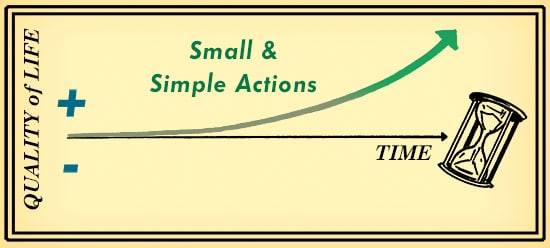
Graphic inspired by The Slight Edge
While Kaizen was originally developed to help businesses improve and thrive, it’s just as applicable to our personal lives, and it’s the antidote to perpetual, puke-inducing rides on the self-improvement roller coaster.
Instead of trying to make radical changes in a short amount of time, just make small improvements every day that will gradually lead to the change you want.
Each day, just focus on getting 1% better in whatever it is you’re trying to improve. That’s it. Just 1%.
It might not seem like much, but those 1% improvements start compounding on each other. In the beginning, your improvements will be so small as to seem practically nonexistent. But gradually and ever so slowly, you’ll start to notice the improvements in your life. It may take months or even years, but the improvements will come if you just focus on consistently upping your game by 1%.
You’ll eventually reach a certain point with your personal development in which a 1% increase in improvement is equal to the same amount of improvement you experienced in the first few days combined. That’s sort of hard to get your mind around, because math. But think about it: 1% of 1 is just .01; 1% of 100 is 1. You’re maybe at a 1 right now, and will only be making tiny improvements for awhile. But stick with it. You’ll eventually reach that 100 level (and beyond) where you’ll be improving by a factor of 1 every day.
That’s the power of the compounding effect.
Why Kaizen Works
“When you improve a little each day, eventually big things occur. When you improve conditioning a little each day, eventually you have a big improvement in conditioning. Not tomorrow, not the next day, but eventually a big gain is made. Don’t look for the big, quick improvement. Seek the small improvement one day at a time. That’s the only way it happens — and when it happens, it lasts.” —John Wooden
The Kaizen approach to self-improvement completely circumvents the unproductive ups and downs all too common to the quest. By breaking down big, overwhelming goals into super small, discrete pieces, Kaizen encourages action. The small successes you experience with your baby steps feed on each other and start building some momentum, which leads to taking bigger and bigger actions.
What’s more, one of the underlying assumptions of Kaizen is that there is no magic bullet that will suddenly make things better. Change comes through small, continuous improvement. Instead of wasting your time searching for the “one thing” that will change everything, Kaizen calmly directs your attention to the task at hand and offers this needed reminder: “You already know what you need to do. Get to work and find small ways to improve along the way.”
Finally, Kaizen isn’t a “one and done” approach to life. It’s a process of continual improvement. You’ll never “arrive” with Kaizen, so the temptation to rest on your laurels once you’ve seen a bit of improvement is reduced. The Kaizen mindset reminds you that all improvements must be maintained if you wish to secure your gains. As Rory Vaden says: “Success isn’t owned, it’s rented. And the rent is due every day.”
How to Implement Kaizen in Your Life
Ask yourself this question every single day: What’s one small thing I can start doing that would improve my life?
Then, start small. Like really small:
- Want to start the exercise habit? Just do a single push-up as soon as you roll out of bed in the morning. The next morning, add another. And so on and so forth. In two months, you’ll be doing 60 push-ups in the morning. In a year’s time, you’ll be giving Charles Bronson a run for his money.
- Want to establish a morning and evening routine? Start with the evening, and concentrate on the 10 minutes right before you go to bed. Plan what you’ll do during those 10 minutes — it can be as simple as brushing your teeth for 2 minutes, flossing for 1, and reading for 7 — and make it a habit. Every day, add 5 more intentional minutes until your whole evening becomes a satisfying routine. Then work on the morning.
- Want to start journaling? Instead of making it a goal to write a page each day, just start off with writing for a minute. That’s it. You might only get a sentence or two down, but that’s okay. The next day, add a minute. In a month, you’ll be writing in your journal for 30 minutes if that’s something you want to do.
- Want to start reading your scriptures more? Start with one.single.verse. Add another verse each day, until you’re reading a chapter a day.
- Want to start meditating? Begin with a minute of breathing exercises. That’s it.
- Want to lose weight? Cut out one sugary drink a day. Or cut your usual afternoon snack in half.
You get the idea. Think of the smallest step you can take that would move you incrementally towards your goal. Then try to make it even smaller.
When tackling big goals, it’s usually advised to only work on one goal at a time, but with the Kaizen approach, working on several things at once it entirely doable.
Try to do just 1% better than the day before. Start small and make your increases gradual. Avoid the temptation to get impatient and start rushing forward and taking bigger leaps. Take it slow, steady, and consistent.
Simply try to do a little bit better than you did the day before.
Yes, the improvements will be gradual. Some days you may not even notice your improvement and it will be tempting to abandon ship and try something else. But with Kaizen, Father Time is your ally. You’ve got to play the long game with your self-improvement — you have to develop what wrestling legend Dan Gable calls the “Patience of Change.”
As my buddy Mark Rippetoe would say, “Just do the program!”
Once you’ve reached your goal, start a maintenance plan, and keep it up for the rest of your life. Lost enough weight? Keep up the manageable diet/exercise plan you’re on, indefinitely. Reached the point where you’re reading 30 minutes a day? Keep it up, and enjoy watching a library of read-books accumulate year after year.
Self-improvement isn’t a destination. It’s a process. It’s like shaving; even though you did it this morning, you’re still going to have to wake up and do it again tomorrow. The process never ends.
Give up on the idea that you’ll someday “arrive.” You’ll never arrive. Instead of focusing on the results of your effort to improve yourself, focus on the process. Joy in the journey, and all that jazz.
And remember this: If you want to maintain the improvement you’ve made, you have to keep doing the things that brought you that success in the first place. Don’t let your early success lull you into a false security, and allow yourself to slack off.
What About Setbacks?
Of course, you’ll encounter setbacks. Some days you may get worse by 1%. That’s okay. It’s just 1% worse. Forget about yesterday and concentrate on today. Get back into the saddle and start doing 1% better again.
Change is possible.
You can get better.
It just takes time and patience.
With small strokes, you shall surely fell great oaks.
http://www.artofmanliness.com/2015/08/10/get-1-better-every-day-the-kaizen-way-to-self-improvement/
http://www.artofmanliness.com/2015/08/10/get-1-better-every-day-the-kaizen-way-to-self-improvement/
Tuesday, 1 March 2016
Subscribe to:
Posts (Atom)